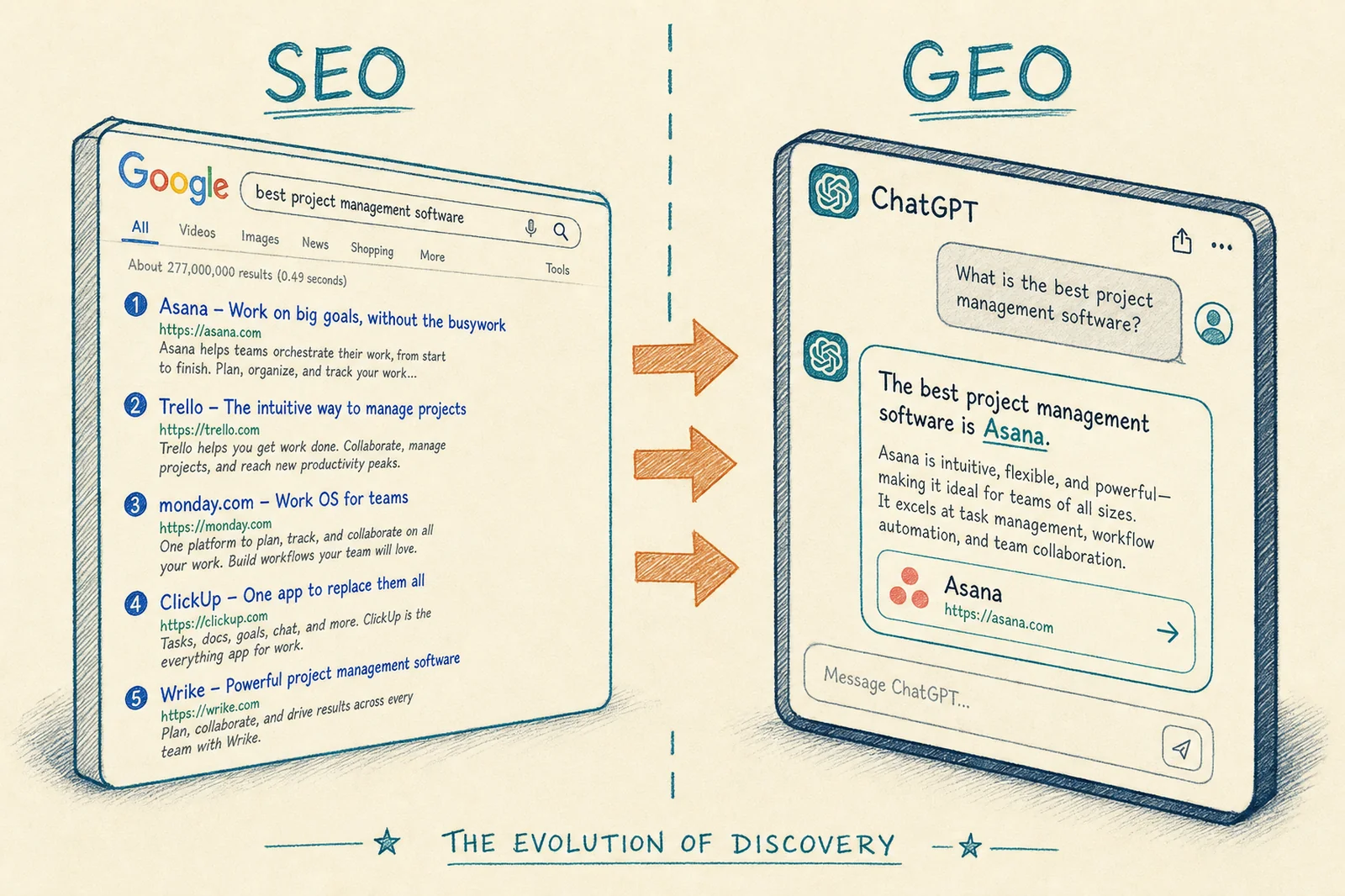
The one-line difference
SEO (Search Engine Optimization) optimizes your site to rank on a search results page, where a person then clicks a link. GEO (Generative Engine Optimization) optimizes your site, data, and reputation so AI engines cite and recommend your business directly inside their answer. SEO competes for a click. GEO competes to be the answer.
What SEO does
Traditional SEO targets the ten blue links. You optimize titles, keywords, backlinks, and page speed so Google ranks you higher, and you win the click. It still matters because most AI engines crawl the same web SEO is built on, and a fast, well-linked site is a prerequisite for both.
What GEO does
When someone asks ChatGPT or Perplexity for a recommendation, there is no list. There is one answer. GEO makes your business the business that gets named. It does that by making your site machine-readable, your expertise quotable, your business data consistent, and your reputation corroborated across the web. Those are the exact signals AI models use to decide who to trust and cite.
Where they overlap
GEO and SEO share a foundation: clean, crawlable, well-structured content. If your site is slow, blocked to crawlers, or thin on content, you lose at both. Good SEO hygiene is table stakes for GEO.
Where they differ
This is where GEO adds layers SEO never required:
- Structured data so AI can parse exactly what you do, where you do it, and why you're trustworthy.
- Answer-first content written the way AI extracts and quotes it, not keyword-stuffed for rankings.
- Entity consistency: your name, services, and expertise stated the same way everywhere AI cross-references.
- Third-party corroboration through reviews, directories, and profiles, all weighted heavily when AI decides who to name.
- AI-specific measurement: tracking AI-referred sessions and crawler activity, not just keyword rankings.
So which do you need?
Both. SEO keeps you competitive in traditional search. GEO lets you compete in AI-first search, which is where a growing share of high-intent buyers now start. The good news is that the GEO foundation reinforces your SEO, so the work compounds. AIOnramp builds the GEO layer on top of your existing presence so you show up in both.