The AI Visibility Gap
Why your business must be visible to AI, before your competitors are.
weekly active AI users searching for businesses like yours, right now
White Paper
The definitive guide to AI-era visibility for service businesses.
A deep-dive on how AI search is reshaping discovery, and the playbook to win before your competitors catch up.
The Shift Is Here
A fundamental transformation is underway in how consumers discover businesses. For two decades, Google Search was the undisputed front door to the internet. Companies invested billions in SEO to climb those blue-link rankings. But today, a seismic shift is redirecting that traffic, and most businesses have not noticed.
Consumers are rapidly adopting AI-powered search tools like ChatGPT, Perplexity, Claude, and Google Gemini. Not just for curiosity, but for real purchasing decisions. Unlike traditional search, which returns a page of links for users to evaluate, AI search delivers direct answers and specific recommendations.
AI does not just surface options. It makes choices.
When a potential patient asks an AI assistant, “Who is the best dentist near me for implants?” the AI does not return ten blue links. It recommends one or two practices by name. If your business is not in that answer, you do not exist to that customer.
weekly active users on ChatGPT alone (Feb 2026)
of consumers now start searches with AI, not Google
of traditional search volume will vanish by end of 2026
The platforms driving the shift
| Platform | Scale | Growth Rate | Key Metric |
|---|---|---|---|
| ChatGPT (OpenAI) | 900M weekly active users | 3× growth in 12 months | 50M+ paid subscribers |
| Claude (Anthropic) | 164M monthly visits | 10.3× traffic in 7 months | $14B annualized revenue |
| Perplexity AI | 170M monthly visitors | 800% year-over-year | 780M queries per month |
| Google Gemini | 750M+ monthly users | 157% growth in 6 months | 1.1B monthly visits |
Sources: OpenAI, Anthropic, Perplexity, Similarweb, Sensor Tower, Gartner (2025–2026)
The Challenge: AI Invisibility
Most businesses have spent years optimizing for Google. They have built websites, created content, managed reviews, and invested in local SEO. But here is the uncomfortable truth: none of that guarantees visibility to AI.
AI search engines do not crawl the web the same way Google does. They rely on structured data, entity recognition, trust signals, authoritative citations, and semantic understanding to determine which businesses to recommend. A beautifully designed website with strong Google rankings can be completely invisible to ChatGPT, Claude, or Perplexity.
- ✕ Optimizes for keywords
- ✕ Builds backlinks for authority
- ✕ Targets page rankings
- ✕ Drives clicks to your website
- ✓ AI understands intent and context
- ✓ AI evaluates structured data and trust signals
- ✓ AI selects specific businesses to recommend by name
- ✓ AI delivers the answer, often without a click
of searches now end without a click. AI provides the answer directly.
“If AI cannot find you, your next customer will not either.”
The new reality of digital discovery.
How AI Chooses Who to Recommend
A single AI query replaces the ten-blue-link browse. The AI ingests intent, evaluates trust signals, ranks matching businesses, and returns one clear recommendation. Here is what that looks like when a customer asks for a local professional.
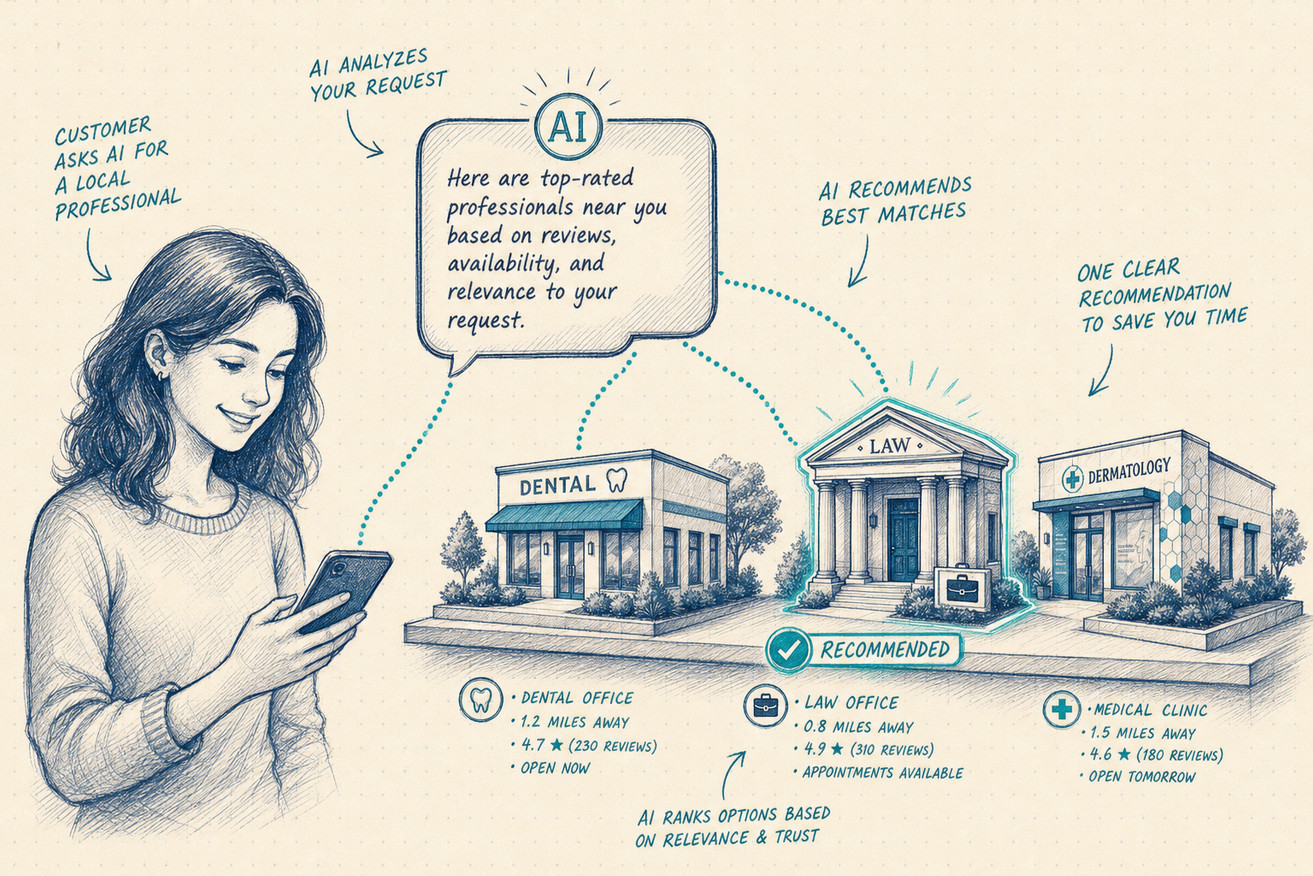
The AI recommendation flow: customer intent, analysis of structured data and trust signals, a ranked recommendation delivered by name. Everything hinges on whether the AI can find, parse, and trust your business at the moment of decision.
The Opportunity: Be Found by AI
While most businesses remain invisible to AI, the early movers have a massive competitive advantage. Generative Engine Optimization (GEO) is the discipline of making your business visible and recommended by AI, and it is delivering measurable results across industries.
of companies optimized for GEO report increased visibility
average improvement in AI recommendation frequency
"Best dentist for dental implants near me"
A patient asks ChatGPT for a recommendation. Without structured data, schema markup, and trust signals optimized for AI, your practice will not be mentioned, even if you rank #1 on Google.
Practices visible to AI can capture 7 to 9 new implant patients per month, worth $42,000 to $54,000 in revenue.
"Best personal injury lawyer for my car accident case"
AI assistants are becoming the first consultation. They recommend specific firms based on case outcomes, specializations, and trust signals, not just ad spend.
AI-visible firms are projected to capture 9 to 14 signed clients per month, representing $108,000 to $168,000 in case value.
"Best orthopedic surgeon for knee replacement"
Patients increasingly trust AI recommendations over generic search results. AI evaluates clinical outcomes, certifications, and patient satisfaction data.
AI-optimized practices can attract 10 to 15 new specialty patients monthly, worth $55,000 to $82,500.
"Most reliable plumber in [city] for emergency repairs"
Homeowners trust AI for urgent recommendations. AI favors businesses with verified reviews, proper licensing data, and structured service descriptions.
Visible contractors can generate 15 to 25 booked jobs per month, worth $45,000 to $75,000 in revenue.
The First-Mover Advantage
The businesses that act now to optimize for AI visibility will enjoy a compounding advantage that becomes increasingly difficult for competitors to close. This is not a marginal improvement. It is a structural shift in how customers find and choose service providers.
Less than 5% of local businesses are optimized for AI. The competitive landscape is wide open. First movers establish AI authority that compounds over time.
Industry publications and conferences begin highlighting GEO. Forward-thinking competitors start investigating. Your head start becomes your moat.
AI search handles 50% of all queries. Businesses scramble to catch up, but early movers have 12 to 18 months of AI trust signals, citations, and authority. Latecomers face a steep climb.
The Compounding Effect
Every month of AI optimization builds trust signals that competitors cannot replicate overnight.
AI models learn and reinforce their recommendations. Early visibility creates a self-reinforcing cycle.
As more consumers shift to AI search, your early investment delivers exponentially greater returns.
How AIOnRamp Makes You Visible
AIOnRamp is the first platform purpose-built to make service-based businesses visible, recommended, and chosen by AI. Our approach combines technical optimization with strategic positioning to ensure AI assistants recognize your business as the authoritative choice in your market.
Server-Side Rendered Websites
We build websites that AI can actually read. Unlike JavaScript-heavy sites that AI crawlers cannot parse, our SSR architecture ensures every page is fully accessible to AI systems.
Structured Data and Schema Markup
We implement comprehensive schema markup, from LocalBusiness and MedicalOrganization to Service and Review schemas. This gives AI the structured context it needs to understand and recommend your business.
Trust Signal Alignment
We align your digital presence with the signals AI models use to evaluate credibility: consistent NAP data, authoritative citations, verified credentials, and quality content.
AI Visibility Monitoring
We continuously track how your business appears across ChatGPT, Claude, Perplexity, and Gemini. We measure mention frequency, sentiment, and recommendation positioning.
Get Your AI Visibility Assessment
Discover exactly how your business appears to AI today, and what it will take to become the recommended choice in your market.
View PricingMaking businesses visible to AI.
hello@aionramp.ai
Sources and References
- OpenAI. ChatGPT usage data and weekly active user reports (February 2026).
- Anthropic. Claude traffic and revenue metrics, Series G announcement (February 2026).
- Perplexity AI. Query volume and user growth reports (2025–2026).
- Gartner. Prediction: Traditional search volume decline of 25% by end of 2026.
- McKinsey and Company. “New front door to the internet: Winning in the age of AI search” (2025).
- Search Engine Land. Consumer AI search adoption study: 37% start with AI (2025).
- Similarweb. AI platform traffic analysis and market share data (2025–2026).
© 2026 AIOnRamp.ai · All Rights Reserved